背景:「现代性」的断裂
Context: the ruptures of modernity
心灵的瓦解:现代心理学兴起the dissolution of mind: the rise of modern psychology
=> 保罗·高更(Paul Gauguin),《我们从何处来?我们是谁?我们往何处去?》Where Do We Come From? What Are We? Where Are We Going?,1897
物质的瓦解:现代科学技术的爆发the dissolution of matter: the explosion of modern science and technology
=> 贾科莫·巴拉(Giacomo Balla),《抽象的速度 + 声音》Abstract Speed + Sound,1913 - 14
1905:「原始主义」,对「再现」的颠覆
“Primitivism” and the overthrow of representation c.1905
色彩的抽象:马蒂斯与野兽派abstracting color: Matisse and Fauvism
=> 亨利·马蒂斯(Henri Matisse),《戴帽子的女人》Woman with the Hat,1905 秋季沙龙展出
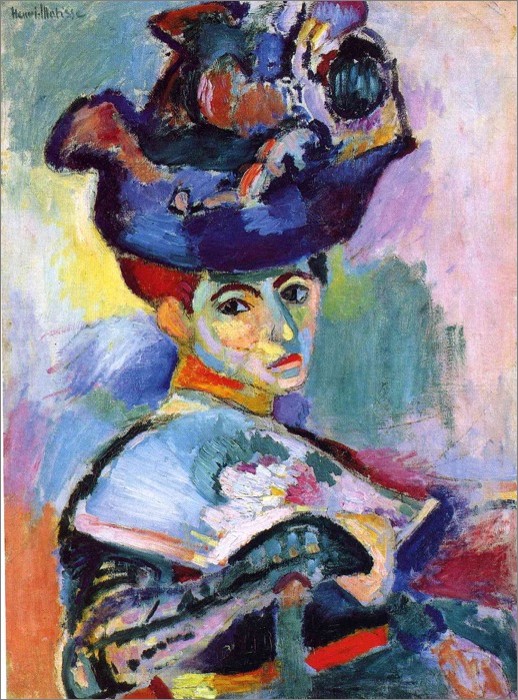
野兽派是法国 20 世纪初期的画派,画风强烈、用色鲜艳大胆,将印象派的色彩理论与梵高、高更等后印象派的大胆涂色技法推向极致,不再讲究透视和明暗、放弃传统的远近比例与明暗法,采用平面化构图、阴影面与物体面的强烈对比,脱离自然的摹仿。
=> 马蒂斯,《生命的欢乐》The Joy of Life,1906 独立沙龙展出
原始主义是一种崇尚「原始」体验的西方美学思潮。它提倡在现代艺术中引入原始(非西方的、史前的)事物。它本质上是一种乌托邦思想,认为天然的才是最好的。虽然在艺术上产生了不少硕果,原始主义也因固化外国「高尚的野蛮人」的形象、美化殖民统治而遭受批评。
abstracting space: Picasso, Braque, and Cubism
=> 巴勃罗·毕加索(Pablo Picasso),《阿维尼翁少女》The Young Ladies of Avignon (Les Demoiselles d’Avignon),1907
=> 毕加索,《我的美人》Ma Jolie 【持吉他的女人】
=> 乔治·布拉克(Georges Braque),《葡萄牙人》The Portuguese,1911【持吉他的男人】
=> 毕加索,《小提琴与果盘》Violin and Compote,1913
立体主义是 20 世纪初在巴黎形成的现代主义艺术运动,通常以毕加索与布拉克在 1907 年前后的探索为起点:它拒绝单一视点与传统透视法,把物体分解为几何化的体块与平面,并将多个角度、不同时间的观看经验在同一画面中并置/重组,从而强调绘画作为二维平面上建构空间与形体的过程;在发展过程中,立体主义从偏灰褐色、结构分析的「分析立体主义」走向加入拼贴、文字与现成材料的「综合立体主义」,揭示视觉与认知结构本身。
抽象,与现代生活
Abstraction and modern life
客观世界的抽象:桥社与未来主义者abstracting the objective world: the “Bridge” and the “Futurists”
=> 恩斯特·路德维希·基希纳(Ernst Ludwig Kirchner),《街道,德累斯顿》Street, Dresden,1908/19
=> 翁贝托·薄丘尼(Umberto Boccioni),《心境状态 I:告别》States of Mind I: Farewells,1911
=> 菲利波·托马索·马里内蒂(Filippo Tommaso Marinetti),《未来主义宣言》Manifesto of Futurism,1909
未来主义是 20 世纪初起源于意大利的艺术与社会运动。未来主义强调动态感、速度、科技、青春、暴力,以及汽车、飞机和工业城市等物象。未来主义歌颂现代性,其理论主张旨在「解放意大利,使其摆脱历史包袱」。
non-objectivity and the mental world: the “Blue Rider”, “Suprematism”, “De Stijl”
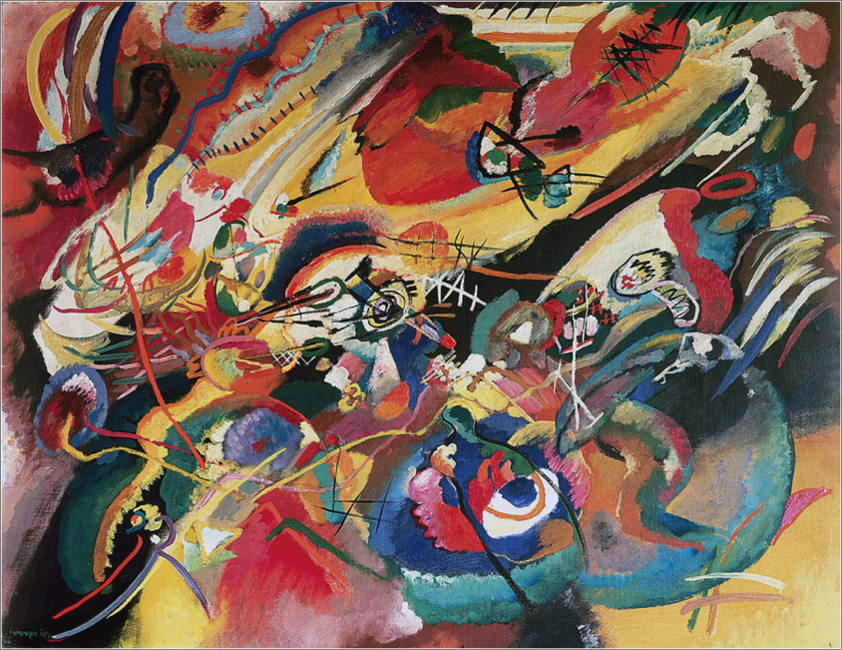
=> 瓦西里·康定斯基(Vasily Kandinsky),《〈构图 VII〉草图 I》Sketch I for “Composition VII”,1913
=> 卡西米尔·马列维奇(Kasimir Malevich),《黑方块》Black Square,1915 于圣彼得堡「0.10」展览展出
=> 卡西米尔·马列维奇,《至上主义构图:飞机飞行中》Suprematist Composition: Airplane Flying,1915 于圣彼得堡「0.10」展览展出
至上主义是 20 世纪初在俄国兴起的一场艺术运动,其核心在于运用几何图形(圆形、方形、矩形)的本质特征,并采用有限的色彩范围进行创作。至上主义的根基在于「纯粹艺术情感的至高性」,而非对现实题材的具象描绘。该词来自于 1915 年马列维奇发表的宣言式小册子《从立体主义和未来主义到至上主义》。
=> 皮特·蒙德里安,《构图:大红色平面、黄色、黑色、灰色与蓝色》Composition with Large Red Plane, Yellow, Black, Gray, and Blue,1921
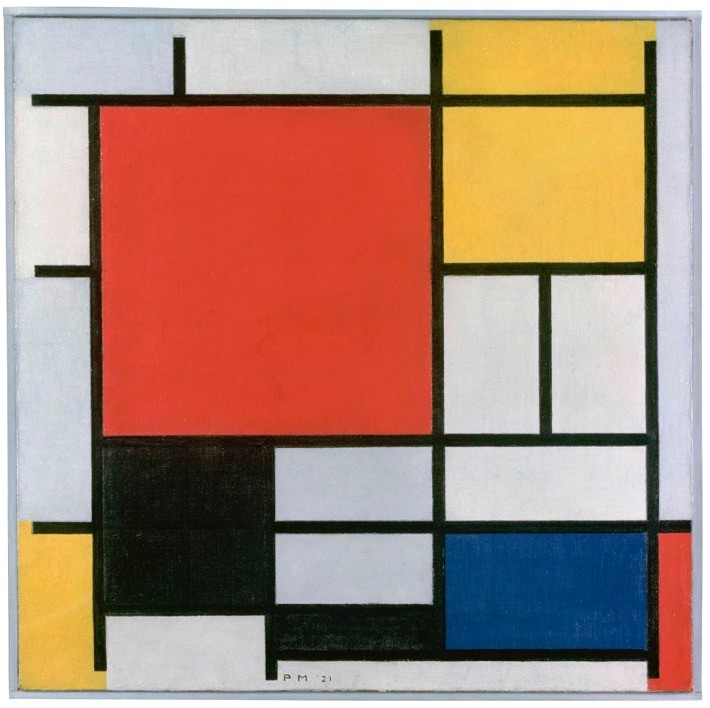
风格派是 1917 年前后在荷兰形成的前卫艺术与设计运动,主张通过极度简化的视觉语言来追求一种普遍、理性且可共享的「新秩序」:在绘画与设计中强调直线与直角、水平/垂直的结构、纯色块(尤其原色)与非对称的平衡,把艺术理解为对形式关系的建构;这种观念也扩展到建筑、家具与平面设计,试图让抽象形式成为现代生活的整体美学与社会理想的表达。
本节名录
- 1895: Guglielmo Marconi (Italy) invents a system for sending and receiving signals using radio waves, initiating the development of wireless communication
- 1899: Sigmund Freud (Austria) publishes The Interpretation of Dreams (《梦的解析》), suggesting that human beings have an unconscious that affects their thoughts and actions
- 1900: Reginald Fessenden makes the first radio transmission of speech, in the U.S.
- 1903: The Wright brothers conduct the first powered airplane flight, which takes place in the U.S. (with the first public demonstrations in 1908)
- 1903: The first Salon d'Automne (Autumn Salon, 秋季沙龙) is held in Paris, to showcase progressive artists who were sometimes rejected from official Salon exhibitions
- 1905: Albert Einstein (Germany) publishes scientific papers outlining the theory of special relativity, which demonstrates that mass can be converted into energy and that time and space are integrated into a single four-dimensional reality
- 1911: Ernest Rutherford (New Zealand) shows that atoms are composed mostly of empty space
- Cubism (立体主义): the name given to the early abstract techniques of Picasso and Braque